For years, many parents have heard the same warning: “Kids shouldn’t lift weights because it can stunt their growth.”
It sounds reasonable. Children and teenagers are still growing, their bodies are developing, and no parent wants an exercise program to interfere with that process.
But what does the research actually say?
When strength training is age-appropriate, properly supervised, and focused on good technique, it can be a safe and beneficial part of a child’s development.
Research supports improvements in strength, movement skills, physical fitness, and athletic development when programs are appropriately designed.
The key is understanding what safe strength training for kids actually looks like.
Strength Training Stunts a Child’s Growth
One of the biggest concerns parents have involves the growth plates, areas of developing cartilage near the ends of children’s bones.
Because growth plates are still developing, protecting them matters. But that does not mean children need to avoid resistance exercise altogether.
Recent pediatric literature supports resistance training as safe and effective for children and adolescents when it is appropriately designed and supervised. A 2025 clinical review notes that developmentally appropriate resistance training can support healthy growth, bone health, muscular strength, endurance, motor coordination, and overall physical development.
The important distinction is between appropriately supervised training and a child simply trying to lift as much weight as possible without guidance.
Those are very different situations.
Strength Training Means Heavy Weightlifting
When parents hear “strength training,” they may picture a child underneath a heavily loaded barbell.
That is not what youth strength training has to look like.
Resistance training for children and teens can include:
- Bodyweight exercises
- Resistance bands
- Medicine balls
- Light free weights
- Exercise machines when appropriate
- Controlled jumping, landing, pushing, pulling, and carrying activities
For younger children especially, the emphasis should be on learning how to move well rather than seeing how much weight they can lift.
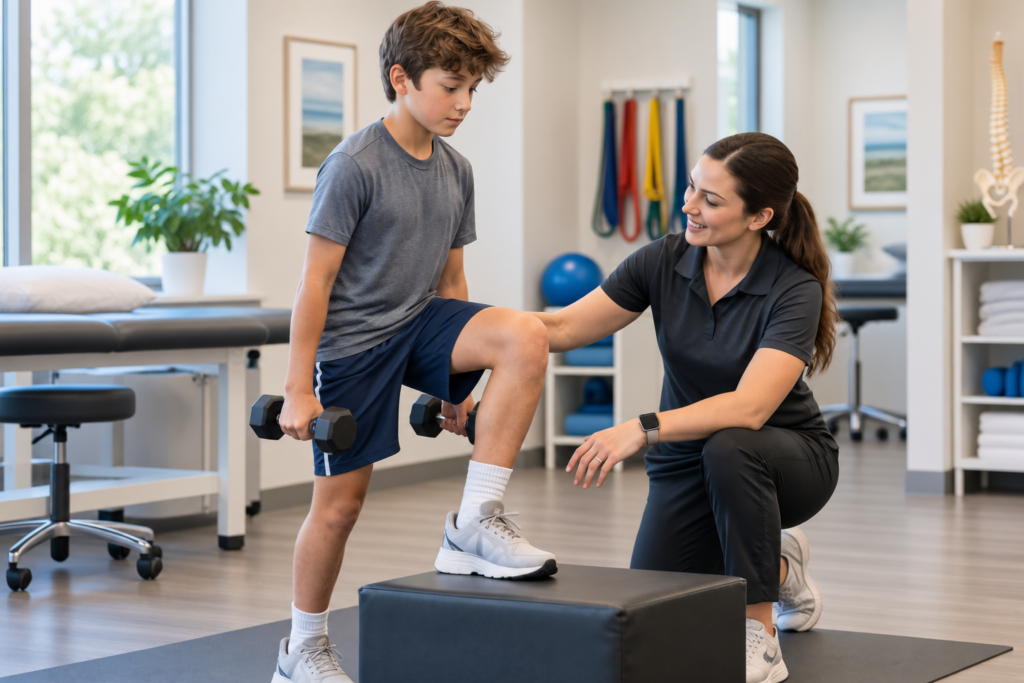
A squat, step-up, controlled lunge, resistance-band exercise, or properly performed push-up can all be forms of strength training.
It’s to help them learn how to move well.
The goal is not simply to create stronger muscles. It is to help children develop the coordination, control, confidence, and physical capacity they need for everyday activity and sports.
Kids Should Wait Until Puberty to Start Strength Training
There is no single age when every child suddenly becomes ready for resistance training.
Instead, professionals should consider factors such as a child’s physical development, maturity, ability to follow instructions, movement quality, training experience, and individual goals.
A 2024 review on strength and conditioning in young athletes emphasized that programs should account for factors including age, maturity level, cognitive ability, puberty status, overall sports participation, and readiness.
That means a safe program for a younger child should not simply be a scaled-down adult workout.
The exercises, resistance, instructions, and expectations should fit the individual child.
Strength Training Is Only for Young Athletes
You do not have to be a competitive athlete to benefit from being stronger.
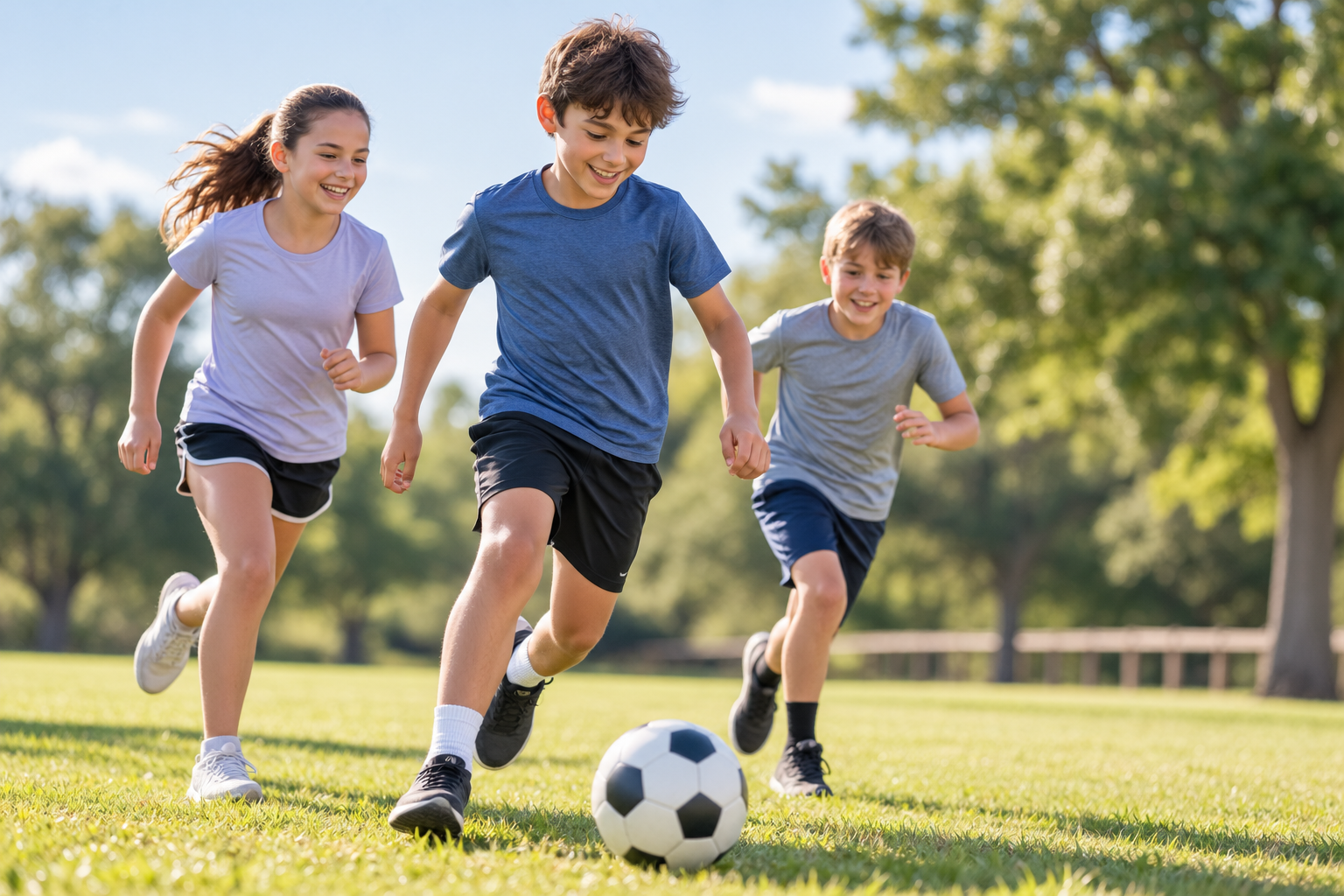
Children use strength when they run, climb, jump, carry a backpack, play outside, participate in PE, and simply keep up with their friends.
For young athletes, appropriate strength training may also help prepare their bodies for the demands of practices and competition. But the larger goal is developing physical literacy: helping kids become comfortable, confident, and capable movers.
A 2025 systematic review and meta-analysis found that supervised strength training can improve multiple measures of physical fitness in children and adolescents.
Potential benefits may extend beyond physical performance as well. A 2023 systematic review and meta-analysis found preliminary evidence of a small positive effect of resistance training on combined cognitive, academic, and on-task outcomes in school-aged youth.
Strength training does not have to be about creating the next star athlete.
Sometimes, it is simply about helping a child build a stronger foundation for an active life.
If Some Weight Is Good, More Weight Is Better
This may be one of the most important points for parents.
Children do not need to chase heavy weights to benefit from strength training.
Resistance second.
Children should learn how to perform movements correctly and consistently before resistance or complexity is increased.
A qualified professional may look at:
- Body control
- Balance
- Alignment
- Range of motion
- Coordination
- Exercise technique
- Fatigue
- Ability to follow instructions
Progress should be gradual and individualized.
More weight is not automatically better. The appropriate challenge is one that allows the child to maintain good movement quality.
So, Is Strength Training Safe for Kids?
The better question may be:
No physical activity is completely risk-free. Running, jumping, playing sports, and even playground activities can result in injuries. Strength training is no different.
Research examining adverse events in youth muscle-strengthening studies also highlights an important limitation: adverse-event reporting has not been consistent across the research literature. That means safety claims should be made thoughtfully rather than suggesting there is zero risk.
What we do know is that supervision, proper instruction, appropriate exercise selection, and gradual progression matter.
Recent research and clinical reviews consistently emphasize these factors when discussing safe youth resistance training.
That is why copying an adult workout from social media or trying to keep up with older athletes is very different from participating in an individualized, professionally guided program.
What Should Parents Look for in a Youth Strength Program?
A good youth strength program should look less like “How much can you lift?” and more like “Can you perform this movement well?”
Children should be taught proper technique, given developmentally appropriate exercises, and progressed based on their abilities rather than comparison with teammates or friends.
Training should also complement the rest of a child’s life. Sports practices, games, school activities, sleep, nutrition, recovery, previous injuries, and overall training volume all matter.
For young athletes in particular, more is not always better.
The goal is to build a body that can handle activity, not simply add another demanding workout to an already packed schedule.
Where Physical Therapy Fits In
For some children and young athletes, strengthening may be part of recovering from an injury, addressing a movement limitation, or preparing to safely return to a sport.
That is where individualized assessment becomes especially important.
At Pro Vita Physical Therapy, we believe exercise should have a purpose.
Our physical therapists look beyond simply making an exercise harder. We evaluate how a patient moves, identify areas that may need improvement, and use objective measures to help guide progression.
For a young athlete recovering from an injury, that may mean rebuilding strength and control before returning to practice or competition. For another child, it may mean improving movement quality, balance, coordination, or confidence.
Not the other way around.
The Bottom Line on Strength Training for Kids
Strength training does not have to be something parents fear.
When it is developmentally appropriate, properly supervised, and focused on technique , resistance training can be a valuable part of helping children become stronger, more confident movers.
The goal is not to turn kids into bodybuilders.
It is to give growing bodies the right challenge, at the right time, with the right guidance.
Helping Young Athletes Move Better
The right exercise isn’t about doing more. It’s about doing what’s appropriate for the individual.
When injury, movement limitations, or return-to-sport concerns are involved, a physical therapist can help determine what is appropriate and how to progress safely.
At Pro Vita Physical Therapy, we use individualized assessment, purposeful exercise, and objective measures to help patients build strength and confidence for the activities that matter to them.
References
- Rabin J, Bowles S, Shin MR. A Practical Guide to Strength/Resistance Training in Pediatrics Ages 7 Through 18 Years Old . Current Problems in Pediatric and Adolescent Health Care. 2025.
- Long C, Ranellone S, Welch M. Strength and Conditioning in the Young Athlete for Long-Term Athletic Development . Sports Health. 2024.
- Moreno-Torres JM, García-Roca JA, Abellan-Aynes O, Diaz-Aroca A. Effects of Supervised Strength Training on Physical Fitness in Children and Adolescents: A Systematic Review and Meta-Analysis . Journal of Functional Morphology and Kinesiology. 2025;10(2):162.
- Robinson K, Riley N, Owen K, et al. Effects of Resistance Training on Academic Outcomes in School-Aged Youth: A Systematic Review and Meta-Analysis . Sports Medicine. 2023;53:2095–2109.
- Mack DE, Anzovino D, Sanderson M, Dotan R, Falk B. Reporting of Adverse Events in Muscle Strengthening Interventions in Youth: A Systematic Review . Pediatric Exercise Science. 2023;35(3):127–143.
