Growing pains in young athletes are often mistaken for sports injuries, especially during periods of rapid growth. While some aches may be a normal part of development, not every complaint of leg pain should be dismissed as “just growing pains.” Understanding how growth spurts affect coordination, performance, and injury risk can help parents know when to monitor symptoms and when to seek professional care.
Are these just growing pains, or is something else going on?
Rapid growth is one of the most significant physical changes a child experiences. During these periods, bones, muscles, tendons, and the nervous system don’t always develop at the same pace. While growth itself isn’t an injury, it can temporarily affect coordination, flexibility, strength, and movement patterns, increasing the risk of sports-related injuries if not managed appropriately.
Understanding what happens during a growth spurt can help parents recognize what’s normal, identify warning signs, and support young athletes through this important stage of development.
What Is a Growth Spurt?
A growth spurt is a period of rapid physical development during puberty when children gain height and body mass more quickly than at other times in childhood.
Sports medicine professionals often refer to Peak Height Velocity (PHV), which is the period when a child experiences their fastest rate of growth.
Although every child develops differently, PHV commonly occurs:
- Girls: around ages 11 to 12
- Boys: around ages 13 to 14
Some children mature earlier or later, so chronological age doesn’t always reflect biological maturity. Coaches, parents, and healthcare providers should consider each athlete’s individual growth and development rather than comparing them with teammates.
Why Do Young Athletes Suddenly Become Clumsy?
One of the biggest surprises for parents is seeing a child who was previously coordinated suddenly appear awkward or unsteady.
This happens because the body is constantly adapting to rapid structural changes.
During a growth spurt:
- Bones lengthen quickly.
- Muscles and tendons may temporarily become tighter because they haven’t caught up with bone growth.
- Balance changes as the body’s center of mass shifts.
- Previously automatic movement patterns need to be relearned.
As a result, young athletes may notice:
- More frequent tripping
- Difficulty landing from jumps
- Changes in running mechanics
- Poor balance
- Less accuracy in throwing or kicking
- Temporary decreases in athletic performance
These changes are usually temporary and improve as the body adapts to its new proportions.
Growing Pains vs. Sports Injuries
One of the biggest misconceptions is that all pain during adolescence is simply “growing pains.”
In reality, growing pains are a specific condition and are not caused by bones growing. They typically occur later in the day or at night, affect both legs, and do not cause swelling, limping, or pain during sports.
Pain that occurs during activity, causes a limp, is localized to one area, or persists over time should not automatically be dismissed as growing pains. It deserves evaluation to rule out a sports-related injury or another medical condition.
| Growing Pains | Possible Sports Injury |
|---|---|
| Usually occurs at night | Occurs during or after activity |
| Often affects both legs | Usually one specific area |
| Improves by morning | May worsen with continued activity |
| No swelling | May include swelling or tenderness |
| No limping | Limping or altered movement may occur |
Why Injury Risk Increases During Growth Spurts
Growing doesn’t cause injuries by itself.
Instead, rapid growth creates conditions that may increase susceptibility when combined with repetitive sports participation and high training loads.
Research shows injury risk tends to rise around periods of rapid growth, particularly for growth-related and overuse injuries.
Several factors contribute.
1. Tight Muscles
Bones often grow faster than muscles and tendons can adapt.
This temporary imbalance may reduce flexibility and increase tension where muscles attach to developing bones.
2. Temporary Weakness
Although children may appear taller almost overnight, strength doesn’t automatically increase at the same rate.
This temporary mismatch can affect jumping, sprinting, cutting, and landing mechanics.
3. Reduced Coordination
The brain must continually adjust movement patterns as body dimensions change.
This temporary “recalibration” may lead to decreased balance and movement efficiency.
4. Increased Training Demands
Many young athletes continue practicing at the same intensity despite their changing bodies.
Without appropriate recovery, repetitive stress can accumulate faster than tissues can adapt.
Common Growth-Related Sports Injuries
Some injuries occur more frequently during periods of rapid growth.
Osgood-Schlatter Disease
Pain develops below the kneecap where the patellar tendon attaches to the shinbone.
Common in athletes involved in:
- Basketball
- Soccer
- Volleyball
- Running
- Gymnastics
Sever’s Disease
Pain occurs at the heel where the Achilles tendon attaches.
Frequently seen in:
- Soccer
- Basketball
- Track
- Baseball
- Football
Patellar Tendon Irritation
Rapid growth combined with repetitive jumping can increase stress around the knee.
Stress Injuries
Although less common, repetitive loading during periods of rapid growth may contribute to bone stress injuries when training volume exceeds the body’s ability to recover.
Signs Parents Should Watch For
Some soreness after sports is expected.
However, parents should pay attention if their child:
- Starts limping
- Frequently complains of the same pain
- Stops enjoying sports because of discomfort
- Avoids certain movements
- Shows noticeable changes in running or jumping
- Experiences swelling
- Has pain that continues for several days
- Cannot keep up with normal practice because of pain
These signs may indicate that an assessment is appropriate.
Should My Child Stop Playing Sports?
Usually, no.
In many cases, complete rest isn’t necessary.
Instead, the goal is to adjust activity while allowing the body to recover.
Depending on the situation, this may include:
- Reducing training volume
- Modifying practice intensity
- Cross-training
- Improving recovery
- Addressing movement quality
Keeping children active while managing symptoms appropriately often produces better long-term outcomes than prolonged inactivity.
How Physical Therapy Can Help Young Athletes
Physical therapy isn’t just for recovering from injuries.
It can also help identify movement changes that develop during growth spurts before they become more significant problems.
A physical therapist may evaluate:
- Running mechanics
- Balance
- Flexibility
- Landing technique
- Hip strength
- Core stability
- Single-leg control
- Sport-specific movement patterns
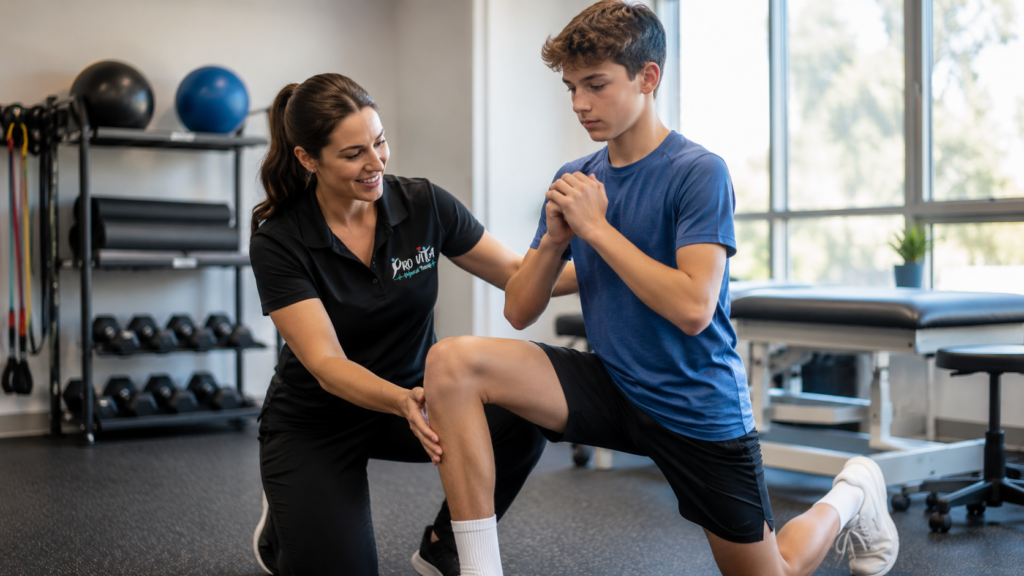
Rather than simply treating pain, physical therapy focuses on improving movement quality so young athletes can continue participating safely while adapting to their changing bodies.
At Pro Vita Physical Therapy, we believe helping young athletes move well today builds healthier movement patterns for years to come. Supporting proper movement during periods of rapid growth may reduce injury risk, improve confidence, and encourage lifelong participation in physical activity.
Tips for Parents During a Growth Spurt
You don’t need to predict every growth spurt, but you can support your child through them.
Encourage Recovery
Growing bodies need adequate sleep, hydration, and nutrition.
Listen to Pain
Persistent pain should never be ignored simply because your child is growing.
Focus on Movement Quality
Good technique often matters more than increasing training intensity during rapid growth.
Avoid Comparing Athletes
Every child matures at a different pace.
Temporary decreases in performance are often a normal part of development.
Communicate With Coaches
If your child recently experienced a significant growth spurt, let coaches know so training expectations can be adjusted if needed.
When Should Parents Seek a Physical Therapy Evaluation?
Consider scheduling an evaluation if your child:
- Has recurring pain during sports
- Frequently develops overuse injuries
- Experiences repeated ankle sprains
- Seems significantly less coordinated after rapid growth
- Has pain that affects participation
- Shows persistent movement changes
- Wants to safely return to sports after an injury
Early evaluation can often identify contributing movement factors before small problems become bigger setbacks.
The Bottom Line
Growth spurts are a normal and exciting part of childhood, but they can temporarily change how young athletes move, perform, and respond to training.
While occasional soreness may be expected, persistent pain, limping, swelling, or pain that interferes with sports should never be dismissed as “just growing pains.”
With appropriate guidance, thoughtful training, and attention to movement quality, young athletes can successfully navigate periods of rapid growth while continuing to enjoy the sports they love.
If you have concerns about your child’s movement, balance, or recurring sports-related pain, a physical therapy evaluation can provide individualized guidance and help them continue building confidence through healthy movement.
References
- Associations between growth, maturation and injury in youth athletes engaged in elite pathways: A Scoping Review. British Journal of Sports Medicine, 2024.
- IOC Consensus Statement on Elite Youth Athletes Competing at the Olympic Games, British Journal of Sports Medicine, 2024.
- Youth Running Consensus Statement: Minimising Risk of Injury and Illness in Youth Runners. British Journal of Sports Medicine, 2021.